- Home
- News
- media news report
- Gukeng Coffee is revived! Use AI to manage the boss's notebook, no longer have to look at God's face
2020-09-22
media news report
Gukeng Coffee is revived! Use AI to manage the boss's notebook, no longer have to look at God's face
Gukeng, once a sacred place for coffee, 15 years ago, because of the mixed bean incident, the confidence of consumers fell to the bottom. In order to "restore" the royal coffee, the Yunlin county government recruited a subsidiary of Wistron to jointly launch a revolution. The scientific and technological agricultural management makes farmers no longer have to look at the face of God.
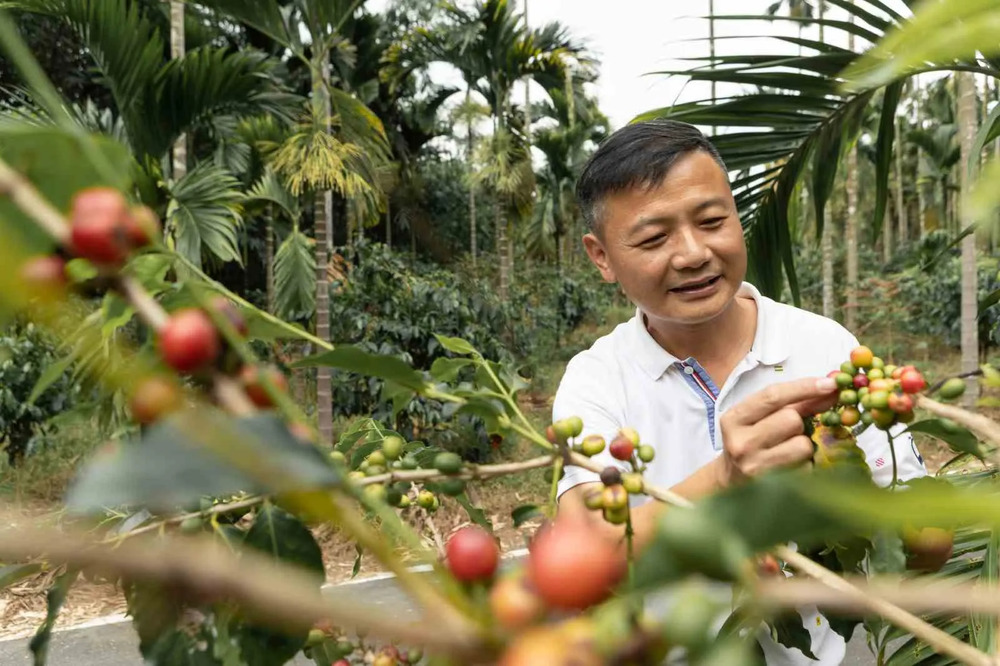
Xu Yihong, chairman of Yunlin Gukeng Coffee Company, wants to revitalize the once famous name of Gukeng Coffee, and bring the place back to life by combining coffee manors and communities. Image source: Photo by Wu Zhouqi
Xu Yihong, chairman of Yunlin Gukeng Coffee Company, wants to revitalize the once famous name of Gukeng Coffee, and bring the place back to life by combining coffee manors and communities. Image source: Photo by Wu Zhouqi
At the end of July, the sun was so red that it made people's scalp numb.
Some of the coffee trees under the betel nut trees in Yunlin Gukeng are blooming small white flowers, while others are full of fruit.
Xu Yihong, chairman of Taiwan's Yunlin Gukeng Coffee Company, lamented, "This year's abnormal flowering may be due to the impact of extreme climate changes. It feels that its life is threatened, and it needs to bear fruit and reproduce the next generation."
In Taiwan, coffee trees bloom up to 7 times a year, and it takes a lot of manpower to pick them in batches, not to mention subsequent processing, roasting, and warehouse management. Every procedure requires manual support, and because of the small production scale, the cost is far It is higher than the imported coffee beans from across the ocean.
However, a "coffee revolution" combining technology is taking place in Gukeng.
With the cooperation between Wistron Group’s subsidiary Weiqian Technology and Yunlin Gukeng Coffee Enterprise, the establishment of intelligent management processes and the use of modern technology to subvert traditional production models have brought new opportunities to the local area, not only attracting young people to return to work, but also the coffee industry. May be born again.
"Agriculture used to rely on aid, and we have to work hard to make agriculture a competitive industry," said Li Mingyue, planning director of Yunlin County Government, who set up a cooperation platform. People who have returned to their hometowns or are on the ground will feel that "someone who is promising" is willing to follow up."
Back in the past, the coffee produced in Gukeng during the Japanese colonial period was paid tribute to the Emperor of Japan by the Governor-General’s Office, and then gradually declined.
It wasn't until 2003 that Yunlin held the first Coffee Festival, which once again earned the name of "Gukeng Coffee", driving the local tourism industry. There were many scenic restaurants everywhere, and there were once hundreds of coffee gardens in the surrounding area.
Why did the emperor's tribute fall?
However, in 2005, it was reported that imported beans were faked as native potatoes and sold at high prices, shaking consumer confidence. Since then, the number of daily visitors has shrunk from a maximum of 30,000 to less than 1,000. There are only 25 left.
Today's Gukeng is no longer as glamorous as it used to be, only the occasional mottled signboards with paint falling off on the roadside.
In order to change the status quo, the Yunlin County Government recruited Xu Yihong, a local who is willing to seek innovation and change, and through the Smart Urban and Rural Program of the Ministry of Economic Affairs, he partnered with Weiqian Technology to allow technology to enter the agricultural field, hoping to make local coffee grow from ( Level 1), baking and processing (level 2), and sales (level 3) industry development model, play a synergistic effect and upgrade to a level 6 industry.

Make good use of big data without looking at God's face
Technology intervenes in field management, so that the flavor of coffee no longer depends on God's face.
"It's a miniature weather detector, and it's placed on the ground so that the monkeys won't take it away." Looking at the hand of Xu Yihong's wife, Guo Cixun, a shining box stood upright on the roof. "We try to live in peace with the monkeys. She added a sentence, implying that the surrounding environment should maintain the most natural ecological style, and wild animals can come and go freely.
Miniature detectors are placed in the field to detect and collect local climate data, including daily temperature, humidity and rainfall, wind, and sunshine changes.
"All the collected data will be uploaded to the cloud," explained Wu Zhongqi, Manager of Wisdom Technology's Cloud Application Service Operation Center.
Because the quality of coffee depends entirely on the local microclimate, as long as the data is in control, the flavor of the coffee produced can be judged from the climate of each year, and even the harvest volume, possible pests and diseases, and early response can be predicted.
Walking into the factory, the roaster makes a rumbling low-frequency sound. On the screen of the laptop on the side, the blue and red curves are constantly changing. The temperature, time and other data of the beans during roasting will be directly input. Confirm whether the best curve is met.
"We will test the most suitable roasting degree and fruity presentation of each batch of coffee beans, and find the most suitable curve for consumers' tastes through the collection of big data," Xu Yihong gestured, even if it is a different roaster, as long as they follow According to the roasting curve, the quality has a certain degree of stability, and it does not need to be inherited by experience, nor does it vary from person to person.
Modern warehouse management keeps coffee fresh forever. There was a strong aroma of coffee in the air. More than 10 young people in pink T-shirts came and went. Some people were lowering their heads, carefully picking out the bad guys with flaws from the plate of yellow coffee beans in front of them.

(Photo by Wu Zhouqi)
(Photo by Wu Zhouqi)
Guo Cixun led the "World" reporter into the small warehouse at the back, where sacks of sacks were piled up one after another. She took out her mobile phone and explained, "There is a QR code on each bag. I just need to scan it to know the small farmers who planted it. And the order of purchase."
Because the quantity and time of delivery of coffee beans produced by each small farmer are different, the purchases in the past were often placed randomly, but when picking up the coffee beans for roasting, they were taken from the most convenient place, so that the beans stacked below were often placed in the get mouldy.
Today, through the warehouse management system, coffee beans can be delivered to consumers in the freshest state on a first-come, first-served basis. Especially the specialty coffee of the main brand TGC (Taiwan Good Coffee) needs to be time-sensitive, and a pound can sell for up to 4,000 Taiwan dollar.

The coffee brand TGC created by Xu Yihong can trace the origin of each packet and find all the information on planting and roasting. (Photo by Wu Zhouqi)
Smart management, young people are more willing to join
The cooperation with Yunlin Gukeng Coffee Company is one of the touchstones for Weiqian Technology to invest in agricultural technology. From coffee, fish farming to chicken farms, Weiqian Technology has gradually entered the deep water area of agriculture.
General Manager Xia Zhihao admits that the Ministry of Economic Affairs' smart urban and rural plan is an incentive for the company, and it is also in line with the mission originally set by Wisdom. Once the cooperation model with the Gukeng coffee company is successful, it will naturally attract more agricultural companies willing to try with open arms.
In the past, all the coffee data from production, roasting to sales, etc. may have been recorded in "the proprietress's little notebook". The Internet of Things and big data solve the needs of agricultural enterprises. From field monitoring, baking and processing to warehouse management, there is a set of automated processes. In addition to building technological infrastructure, it also improves the business environment.
"Now there are more and more coffee farmers contracted. Apart from Gukeng, there are also farmers from Guoxing and Ren'ai Township in Nantou to Sandimen in Pingtung, etc.," said Xu Yihong. The coffee farmers encountered problems in planting and took pictures. By uploading directly to the system, solutions can be imparted through online teaching to achieve intelligent and friendly management, so that young people are more willing to invest, and he can also control the safety of the coffee planting process.
At noon during the week, the Dapu Community Inn, which is about 1 kilometer away from the coffee farm of Yunlin Gukeng Coffee Enterprise, is full of people, all of whom come here to taste bamboo shoots at noon.
After a full meal, walking or cycling along the Songbai River, all the way to the manor to drink coffee brewed on site and visit the coffee factory, has become the most popular small rural travel itinerary in this secluded village.
Will the once prosperous scenery return to Gukeng again? After the previous wave of novelty hunting, this unique Arabica flavor grown from the land may be the key to open the door. (Editor in charge: Chen Yuyan)
Source: Interview and compilation of "World Magazine Issue 707"
 Previous
 Back
Back


